
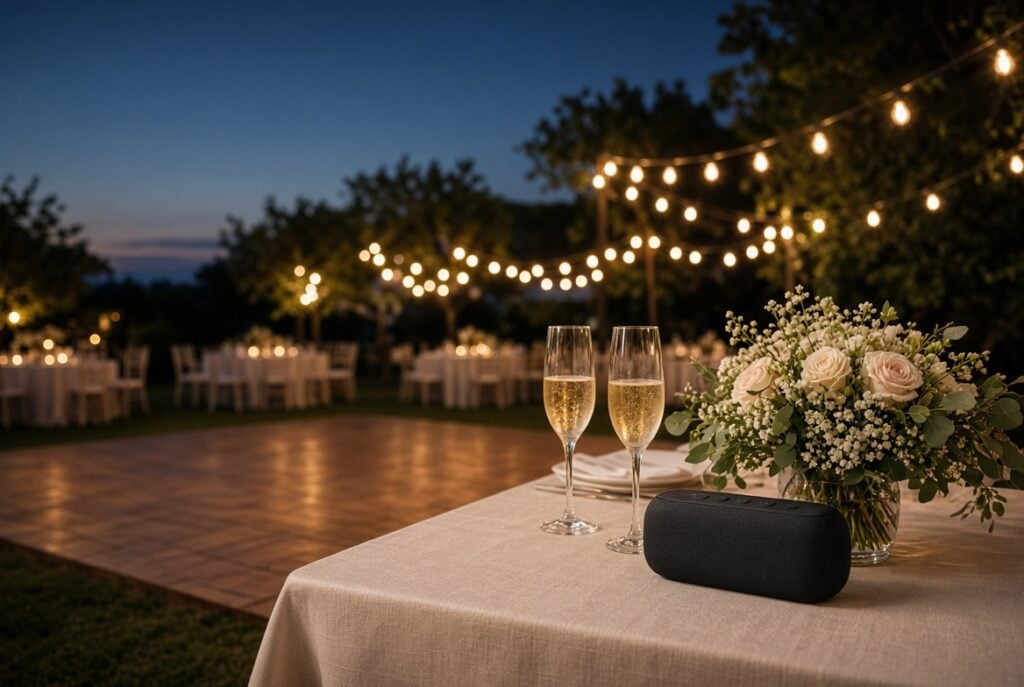
Yes, you can absolutely have a wedding without a DJ. What you gain is real: budget breathing room and total control of every song. What you lose isn’t the music itself, it’s the five jobs someone was quietly doing around the music all night.
Those jobs don’t vanish when the line item does. They shift to you, to a guest, or to nobody at all. And in New South Wales, a couple of them are legal obligations you can’t really hand to your cousin with the good speakers.
We’ve been running receptions across Newcastle and the Hunter Region for over a decade at Avid Entertainment, and this post isn’t a sales pitch for hiring us. It’s the honest ledger we wish more couples had before they made the call. If you haven’t decided anything yet and you’re still weighing up the basics, if you are still deciding whether to hire anyone at all, start here.
Yes. It works best at small, seated weddings where nobody’s expecting a proper dance floor.
Here’s where it gets interesting though. Nearly every article telling you to just build a playlist adds the same caveat: it’s fine if you’ve got under 50 guests. According to Easy Weddings data, only around 6% of Australian weddings actually have fewer than 50 guests. The average sits at roughly 88.
So that advice, written as though it applies to everyone, really applies to about one couple in sixteen.
For the other 94%, the jobs are still there. The question isn’t whether you need a DJ. It’s whether you’ve worked out who’s doing the five things a DJ does.
We’d rather be straight with you than pretend there’s no upside. There is.
Budget room. The Easy Weddings 2026 Australian Wedding Industry Report, drawn from a survey of more than 4,000 couples, puts average Australian wedding spend at $38,252, up around 8% year on year. The music and DJ category averaged $2,142 nationally, roughly 5.6% of the total. Venue alone accounted for about 46%. That’s a national average from a published report, not a quote for your date, but it tells you where the money sits.
A song list that’s completely yours. No compromise, no reading of the room overriding your taste. Every track is one you chose.
A quieter room. Some couples genuinely want conversation over volume. A long, relaxed dinner with music underneath it is a legitimate wedding.
Nobody extra in your photos. One less supplier moving through the background of your day.
Fewer suppliers to manage. The Knot Worldwide’s 2026 Real Weddings Study, published in February 2026, found US couples used an average of 13 wedding professionals. Cutting one is one fewer contract, one fewer arrival time, one fewer person to brief.
If those things matter more to you than a packed dancefloor, that’s a reasonable trade. Just make it knowingly.
We started calling these the Five Handovers because that’s what they are. Not risks, not warnings. Just five jobs that move somewhere else when the DJ isn’t there.
Handover | What the job actually involves | Who it lands on without a DJ |
Sound | Speakers sized to the room, ceremony PA, cordless mic for the celebrant, coverage reaching the back tables | You, or hired gear you set up yourself |
Sequence | The run sheet, meaning the minute-by-minute schedule of the reception, plus every cue in it | You, on your own wedding day |
Steering | Reading the floor and changing the next track based on who’s actually dancing | Nobody. A playlist can’t watch the room |
Speaking | Announcements. Telling the room what happens next, repeatedly, for five or six hours | A guest, usually one who’d rather be drinking |
Safeguards | Public liability cover, tested equipment, backup gear when something dies at 9pm | You, and often unknowingly |
A speaker that fills your living room won’t fill a function room with 88 people talking over it. Ceremony audio is its own separate problem, because a celebrant needs a cordless microphone and vows need to reach the back row outdoors, where there are no walls to help.
Speeches run long. The cake gets delayed. A playlist doesn’t pause and it doesn’t restart. It just keeps going, which is how you end up with your grandmother’s favourite song playing over the top of an uncle’s toast.
We take a fairly open-format approach at most receptions, choosing from tens of thousands of tracks based on the time of night and who’s on the floor right then. That decision gets made dozens of times across an evening. A locked playlist makes zero.
Whoever holds the mic is working. They’re watching the room, chasing the bridal party, and not sitting with their dinner. It’s a real ask, and it lasts the whole night.
This is the handover almost nobody sees coming, so it gets its own section below.
Short answer: the venue usually does, not you. But it’s worth knowing where you stand.
OneMusic Australia, the joint licensing initiative between APRA AMCOS and PPCA launched on 1 July 2019, treats music played during a wedding ceremony as a domestic use and doesn’t seek a public performance licence for it.
Receptions are treated differently. OneMusic’s published position is that when music is played at a dedicated wedding reception venue, it expects that venue to hold a OneMusic Function, Convention and Conference Centres licence. Without one, music used at wedding receptions may be infringing copyright. That licence covers background music used by the venue or by someone who has hired the venue, which includes you and your laptop.
In a Music Licensing 101 session run with the Australian Copyright Council in late 2025, OneMusic addressed this directly: buying music, subscribing to a music service, or switching on a radio or TV doesn’t grant the right to perform or play that music in a public setting.
Spotify’s own Terms and Conditions of Use grant limited, non-exclusive, revocable permission for personal, non-commercial use. Its support page on public and commercial use states the service can’t be broadcast or played publicly from a business. Apple Music, YouTube Music and Amazon Music consumer terms carry the same personal-use restriction.
One practical detail worth knowing if you’re relying on downloads at a rural venue: Spotify’s help documentation states you need to go online at least once every 30 days or downloaded tracks are automatically removed from the device.
Where it gets less clear: a reception at a farm, a private property or a hired marquee site isn’t a licensed function venue. That’s genuinely grey territory and we’re not going to pretend otherwise. Check with OneMusic Australia and ask your venue in writing whether it holds a current public performance licence.
That’s a conversation we’ve had with venues across the region more times than we can count. Most couples plan one wedding in their life and have never had it once.
At a licensed venue, the venue’s own conditions govern. On residential property, the rules are specific and enforceable.
The Protection of the Environment Operations (Noise Control) Regulation 2017 sets out when musical instruments and sound equipment must not be heard inside a habitable room of a neighbouring residence. The Regulation’s list includes radios, televisions, sound reproduction equipment, public address systems, computer games, amplifiers and home theatre systems.
Day | Restricted hours |
Friday, Saturday, or the day before a public holiday | Midnight to 8am |
Any other day | 10pm to 8am |
A habitable room means any room other than a garage, storage area, bathroom, laundry, toilet or pantry. The penalty for a breach is $200 for an individual and $400 for a corporation, with a maximum a court can impose of $5,500 and $11,000 respectively.
Worth knowing: under the POEO Act 1997, “offensive noise” can be found at any time of day or night. Those time restrictions are additional controls, not permission to be loud inside those hours. Details are on the NSW EPA neighbourhood noise restrictions page.
The 24-Hour Economy Legislation Amendment (Vibrancy Reforms) Act 2025 passed NSW Parliament in November 2025. It automatically removes certain licence conditions imposed before 24 November 2022 that restricted live music or entertainment or set sound limits. Liquor & Gaming NSW is stripping these from individual liquor licences throughout 2026, and venues don’t need to apply.
The formal disturbance complaint threshold also rose from three complainants to five, from different households, who must first attempt to resolve things with the licensee. As at March 2026, 564 venues were registered for live music incentives, up from 133 before the reforms, with 158 of those in regional NSW. You can read the details on the Liquor & Gaming NSW venue sound reforms page.
Here’s the catch. Those protections apply while a venue is licensed under the Liquor Act 2007. L&GNSW can also reimpose a condition if problems arise.
A reception in a paddock, a backyard or a hired hall gets none of that relief. It falls back to the neighbourhood noise rules above. And those are exactly the sites couples going without a DJ tend to choose.
Two documents come up constantly, and neither is something you can produce on the day.
Public liability insurance. City of Newcastle classes a wedding ceremony as Low Impact and generally won’t ask a casual private hirer for public liability cover, provided the plan stays within the scope of the application form. But if you engage a third-party vendor, Council requires that vendor’s public liability insurance with a minimum of $20 million cover, current on the event date, submitted with the application. For outdoor event space bookings, the certificate must name the City of Newcastle as an interested party, and at least four weeks’ notice applies. Upper Hunter Shire Council’s reserves and parks terms similarly require $20 million cover with an original Certificate of Currency naming the Council.
Tested and tagged equipment. AS/NZS 3760:2022 covers in-service safety inspection and testing of electrical equipment, and venues commonly require BYO electrical appliances brought on site to be tested and tagged, because the venue is meeting its own Work Health and Safety duties. Published industry guidance notes this routinely captures audio visual equipment, heaters, fans, fairy lights, festoon lighting and chargers at weddings. Testing must be done by a competent person using a portable appliance tester. Anything with a cord, cable and plug operating above 50 volts is in scope, including extension leads and portable RCDs.
Hired speakers, a borrowed power board and three extension leads across a marquee floor sit squarely inside that. A supplier turns up with gear already tested, tagged and documented. A couple hiring equipment for one night usually doesn’t.
Our LED dancefloor hire in Newcastle is insured under our public liability policy and we can supply a Certificate of Currency on request. That’s the exact document councils and venues ask for, and it’s the sort of thing that’s easy to overlook until someone asks for it a fortnight out.
A fair caveat: requirements vary by venue and by council. Ask your venue for its supplier requirements in writing, and talk it through with a professional before you commit to anything.
No, not at a City of Newcastle park or beach. Council states plainly that it won’t approve a wedding reception at these sites, citing noise, anti-social behaviour and safety. Ceremonies only.
If you’re planning a ceremony at one of them, a few published conditions are worth reading before you plan around them:
That second point catches people out. Every speaker, stand, cable and battery gets carried in by hand, usually by a guest in good shoes. Full conditions are on the City of Newcastle park and beach wedding conditions page.
Central Coast Council’s wedding ceremony booking conditions also restrict vehicles on oval, park, beach and reserve areas, requiring loading and unloading from a marked parking bay, with infringement notices possible and bonds refunded after site inspection.
Councils differ more than you’d expect. Randwick City Council, as one NSW comparison, permits no amplification over 72 decibels in its parks and beaches and provides no electrical power at all. Eurobodalla Shire Council doesn’t allow receptions on public land and requires items to be carried in and out.
Check your specific council for your specific site. The answer changes from one reserve to the next.
There’s actual peer-reviewed work here, and it’s more interesting than the usual “music brings people together” line.
Researchers at the University of Oxford ran a study published in Biology Letters in 2015, with 264 participants in a 2×2 experimental design. Synchrony and exertion each produced significant independent positive effects on pain threshold, used as a proxy for endorphin activation, and on in-group bonding.
A follow-up study by the same team, published in Evolution and Human Behavior in 2016 and known as the silent disco study, sharpened it further.
Participants who danced in synchrony showed elevated pain thresholds. Those in the partial synchrony and asynchrony conditions showed no analgesic effect at all. Tarr, Launay and Dunbar, University of Oxford
To be clear, this research is about group dancing in general, not weddings specifically. But the finding is worth sitting with. The measurable effect came from people moving to the same thing at the same time. A floor that fills, empties, and half-refills between tracks doesn’t create that condition.
That’s the thing a locked playlist can’t do. It can’t notice the floor thinning at 9:40 and change what happens next.
We’re not going to pretend it never does. It works, and here’s the honest shape of it.
It tends to work when:
It tends to fall over when:
If you read that first list and thought “that’s us,” you probably don’t need to book anyone. That’s a real answer and we’re comfortable giving it.
Most of what’s above depends entirely on where you’re getting married. A licensed function centre in Newcastle carries obligations your farm site doesn’t, and the reverse is true too.
That’s the conversation worth having before you decide, and it takes about fifteen minutes. We’ll go through your venue, your run sheet and which of the five handovers land on you, and if the answer is that you don’t need us, we’ll say so. Some couples come out of that call and confidently build their own playlist. Others realise the ceremony PA and the announcements were the real gap.
You can talk through your reception with us at Avid Entertainment whenever you’re ready. If you’d rather do more homework first, the questions worth asking before you book covers what separates a good supplier from an average one.
What happens at a wedding reception if you do not have a DJ? The music keeps playing, but nothing else adjusts. There’s no one changing the next track when the floor empties, no one pausing for a speech that runs long, and no one announcing the cake cutting. Most couples find the announcements are the gap they feel first, not the music.
Can I use Spotify at my wedding reception? Spotify’s Terms and Conditions of Use grant permission for personal, non-commercial use, and its support page states the service can’t be broadcast or played publicly from a business. A licensed venue holding a current OneMusic Functions licence covers the public performance right for that room regardless of the source. The streaming account’s own terms are a separate layer. Confirm your venue’s licence position with the venue and check OneMusic Australia for the licensing detail.
Is it cheaper to have a wedding without a DJ? It removes one line item, though not always as much as expected once hired speakers, extension leads, testing and any insurance requirements are added back. The Easy Weddings 2026 report put the national average music and DJ category at $2,142 against average total spend of $38,252. Those are national averages from a published survey, not a quote, so ask any supplier for pricing on your actual date and venue.
Who runs the reception if there is no DJ? Usually a guest, and usually one who wasn’t warned how much of the night it takes. Whoever holds the microphone is working from the bridal party entrance through to the last song. It’s worth asking that person directly, well in advance, rather than assuming someone will step up.
Does my wedding equipment need to be tested and tagged? Venues commonly require it for BYO electrical appliances, because they’re meeting their own duties under AS/NZS 3760:2022 and Work Health and Safety law. Guidance in the field notes this regularly captures audio visual gear, festoon lighting and extension leads at weddings. Requirements differ by venue, so ask yours for its supplier requirements in writing.
Do I need public liability insurance for my wedding? For a ceremony at a City of Newcastle park or beach, Council generally won’t ask a casual private hirer for it, provided the plan stays within the application form’s scope. If you engage a third-party vendor, Council requires that vendor’s cover at a minimum of $20 million, current on the event date. Other councils set their own rules, so check with the one managing your site.
What is the difference between a wedding DJ and a wedding MC? The DJ handles music and sound. The MC handles the room, meaning announcements, timing and keeping guests informed about what’s coming next. Combining both in one person is the most common arrangement among the couples we work with, mainly because the two jobs constantly need to talk to each other.
Can you have a wedding without an MC? You can, and small seated weddings often do fine. The trade-off is that transitions become fuzzy, guests aren’t sure when to sit or move, and the couple ends up directing their own day. If you’re planning speeches, a cake cutting and a first dance, someone needs to be calling those moments.